What it does
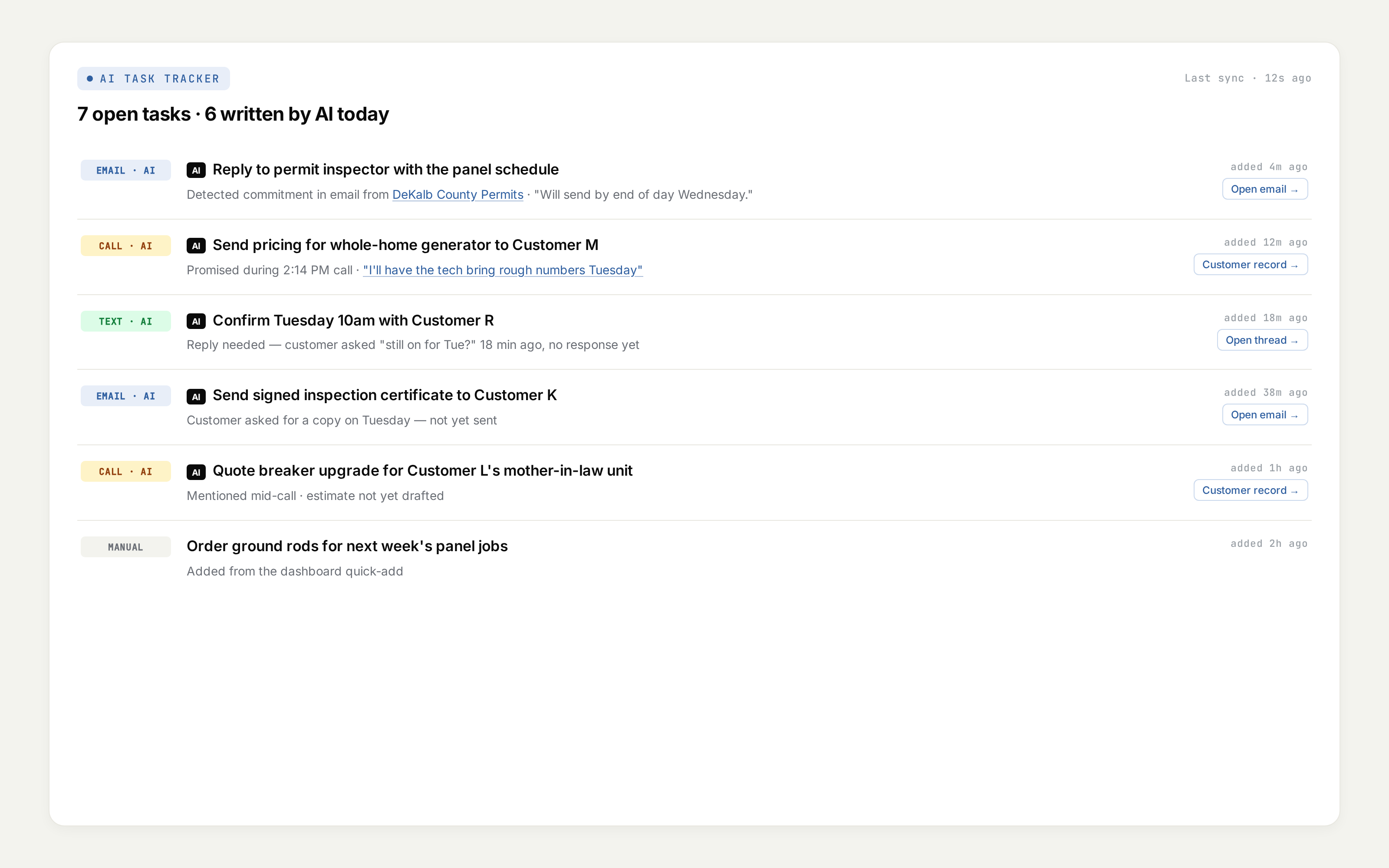
- AI reads every inbound email and writes a task automatically when action is needed. Linked back to the original email.
- AI reads every transcribed customer call (see Call Transcription) and writes a task when someone on your team makes a commitment — "I'll send the quote tomorrow", "we'll text the address".
- AI does the same for texts and chat: watches threads, writes tasks the moment something is promised.
- Manual quick-add is still there for anything you want to add yourself — type, hit enter, done.
- Every AI-written task carries a link back to the source (email thread, call transcript, customer record), so the context is one click away.
Where tasks come from
How it works
Every customer communication runs through an AI assessment layer. The model reads with your business context: is something being promised? Is action needed from your team? Is it just an FYI?
When the answer is yes, a task is created instantly with a clear title, a one-line context, and a link back to the source — so a click takes you straight to the email, the call transcript, or the customer record.
Tasks live in one place: the dashboard, your inbox, Telegram, Slack — wherever you already work. Mark one done and it clears across all of them.
The stack
Claude (Anthropic) or GPT-4 (OpenAI) for commitment detection. Provider hooks for Gmail, transcripts (Whisper/Deepgram), SMS (Twilio, OpenPhone). Lightweight Python orchestrator, SQLite for task state, Telegram for human-in-the-loop.
Who it's for
Teams that keep dropping balls because somebody made a promise on a call and forgot to write it down. Service businesses, sales teams, anyone whose best customers churn because a single follow-up slipped.